
No 6838
Wednesday 7 October 2026
Vol clvii No 3
pp. 21–37
7 October, Wednesday. First ordinary issue of the Reporter in the 2026–27 academic year.
18 October, Sunday. Preacher before the University at 11.30 a.m., The Right Reverend Martin Seeley, of Jesus College, formerly Bishop of St Edmundsbury and Ipswich and sometime Principal of Westcott House (Select Preacher).
19 October, Monday. Ballot of the Regent House, voting opens at 10 a.m.
20 October, Tuesday. End of first quarter of Michaelmas Term.
29 October, Thursday. Ballot of the Regent House, voting closes at 5 p.m.
|
Discussions (Tuesdays at 2 p.m.) |
Congregations (at 10 a.m. unless otherwise stated) |
|
10 November 15 December |
23 and 24 October 28 November |
The Vice-Chancellor delivered an address to the University on Thursday, 1 October 2026. In line with previous years, the text of the address is reproduced on p. 32 below.
The Vice-Chancellor gives notice that an election is to be held to appoint eight members of the University Council for four years from 1 January 2027. Members are to be elected in the following classes under Statute A IV 2:
(a)two from among the Heads of Colleges;
(b)two from among the Professors, Clinical Professors, Readers and Professors (Grade 11);
(c)four from among the other members of the Regent House.
The Council is the principal executive and policy-making body of the University. It has general responsibility for the administration of the University, for defining its mission, for the planning of its work, and for the management of its resources. The Council deals with relations between the University and the Colleges, and conducts negotiations with outside bodies on many matters (other than those relating directly to the educational and research programmes of the University, which are dealt with on its behalf by the General Board of the Faculties). It is responsible for the appointment or nomination of certain members of internal and external bodies, and for many student matters (excluding undergraduate admissions, which is a College concern). Further information about the Council is available to members of the University on the Council website (https://www.governanceandcompliance.admin.cam.ac.uk/university-committees/university-council). Questions about its work can be addressed to the Director of Governance and Compliance by emailing registrary@admin.cam.ac.uk.
The University is committed to equality, which includes supporting and encouraging all under-represented groups, promoting an inclusive culture, and valuing diversity. Nominations from groups that are under-represented on the Council are welcomed.
The Council of the University of Cambridge is one of the few principal bodies in the higher education sector with a majority of members elected from internal constituencies; most equivalent bodies are made up predominantly of external members. The Council draws its strength from the expertise, engagement, and scrutiny of its members – those elected in the classes noted above as well as its external and student members. It is key to the continuing success of the University that elections to the Council attract strong candidates who are willing to share their knowledge and commit their time for the benefit of the University as a whole.
The University is both an exempt charity,1 and a corporation established by common law. Council members are therefore both charity trustees of the University and, effectively, its corporate directors. They have associated legal responsibilities and duties, including the promotion of the interests of the University and acting with integrity, care, and prudence. Under regulatory guidance, Council members must be ‘fit and proper persons’.2 It is important for candidates to recognise and accept the obligations that Council membership would confer upon them.
The Handbook for Members of the Council sets out the Council’s primary responsibilities and provides advice and guidance to members of Council on their legal and other responsibilities. Members of the Council are expected to attend all meetings of the Council. Members will not normally be able to take more than one term of leave during their period on the Council and may instead carry forward their leave entitlement. Potential nominees might wish to familiarise themselves with the key aspects of the University’s Statutes and Ordinances (https://www.admin.cam.ac.uk/univ/so/), and the most recent Budget Reports, Annual Reports and Financial Statements.3
Further useful information is provided by the Office for Students (https://www.officeforstudents.org.uk/for-providers/), and the Charity Commission (https://www.gov.uk/government/publications/the-essential-trustee-what-you-need-to-know-what-you-need-to-do-cc3). This information includes details of the extent of a charity trustee’s personal liability. Instances of personal liability are rare and unlikely to occur, providing trustees act honestly, prudently, in good faith, in the best interests of the University, and in compliance with legislation and the University’s governing documents.
In order to be eligible, candidates for election are asked to send their nominations to the Vice-Chancellor, to be received not later than 12 noon on Friday, 13 November 2026. The Vice-Chancellor asks candidates to address their nominations to the Director of Governance and Compliance by email including electronic signatures to registrary@admin.cam.ac.uk. The nomination (which can be made on a form available on the Regent House site)4 should include (a) a statement signed by two members of the Regent House, nominating the candidate for election and specifying the class in which the candidate is nominated, and (b) a statement signed by the candidate confirming consent to be nominated. The candidate is also required to provide a personal statement by the same date (see below). No-one may be nominated for election in more than one class. Two periods of four years should normally be regarded as the maximum length of continuous service for elected members of the Council.
In accordance with the regulations governing the election (Statutes and Ordinances, 2025, p. 119), those standing for election should send to the Director of Governance and Compliance, by 12 noon on Friday, 13 November 2026, a statement in support of their nomination, which will be provided to voters. Each statement should be no more than 500 words in length and should cover the following points:
•the candidate’s present position in the University;
•previous posts held, whether in Cambridge or in other universities or outside the university system, with dates;
•the candidate’s reasons for standing for election, and the experience and skills they would bring to the role;
•a note of the candidate’s particular interests within the field of University business.
The complete list of nominations will be published in the Reporter on Wednesday, 18 November 2026.
If the election is contested, it will be conducted by ballot under the Single Transferable Vote regulations. Online voting will open at 10 a.m. on Monday, 23 November 2026 and close at 5 p.m. on Thursday, 3 December 2026. Hardcopy voting papers and supporting materials will be distributed not later than Monday, 23 November 2026 to those who opt by 30 October 2026 to vote on paper (see p. 24); the last date for the return of voting papers is 5 p.m. on Thursday, 3 December 2026.
1The University has charitable status but is exempt from the statutory requirement which otherwise obliges a charity to register with the Charity Commission. The Office for Students is the principal regulator of the University as regards its compliance with its legal obligations in exercising control and management of its administration as a charity.
2For a full definition of ‘fit and proper persons’, see: https://www.officeforstudents.org.uk/for-providers/registering-with-the-ofs/registration-with-the-ofs-a-guide/public-interest-governance-principles/.
3See: https://www.reporter.admin.cam.ac.uk/annual-reporting.
4Nomination forms are available at https://universityofcambridgecloud.sharepoint.com/sites/RegentHouse/SitePages/elections.aspx (University account required).
The timetable for the election to the Board of Scrutiny has changed since first publication on 30 September (Reporter, 6837, 2026–27, p. 19). The election to the Board will now follow the timetable for the Council election noted above, with voting opening at 10 a.m. on 23 November and closing at 5 p.m. on 3 December 2026.
The draft Roll of the Regent House for the 2026–27 academic year (i.e. the list of names proposed to be placed on the Roll when it is promulgated in November) was published within Reporter Special No. 1 on 1 October 2026 (see https://www.admin.cam.ac.uk/reporter/2026-27/special/01/).
The draft Roll is based on data derived from CHRIS, the University’s HR database, and takes account of the provisions on membership contained in the University’s Statutes and Ordinances. Some significant changes to the eligibility criteria for membership of the Regent House came into effect in November 2022, including the move to a grade-based model (Grade 9+) for University staff. Links to the rules governing membership are provided in the Notice by the Director of Governance and Compliance in the Special issue.
Current and prospective members of the Regent House are asked to check the draft Roll and membership provisions and to make sure that their entries are correct. Notice of any corrections or amendments should be sent by email to the Director of Governance and Compliance via UniversityDraftsman@admin.cam.ac.uk as soon as possible; any corrections received by 12 noon on Wednesday, 14 October 2026 will be included in the definitive Roll, which is to be promulgated on 6 November this year.
The Roll promulgated on 6 November 2026 constitutes the list of eligible voters for elections to the Council or Board of Scrutiny and any ballots of the Regent House that may be called during the year1 until the promulgation of the next Roll in November 2027. Once promulgated, the November 2026 Roll cannot be changed and corrections, amendments or additions are not permitted.
1See the Ballots Notice on p. 24.
Further to the Notice published on 23 September 2026 (Reporter, 6836, 2026–27, p. 10), preliminary lists of Faculty members are now available on the Reporter website at https://www.reporter.admin.cam.ac.uk/faculty-membership-lists, where further information, including deadlines and links to the lists on Faculty webpages can also be found.
Any corrections or amendments should be sent to the Secretary of the Faculty Board concerned by the stated deadline. The final list for each Faculty will be promulgated by the Secretary of the Faculty Board no later than 6 November 2026.
Online voting is the default voting method in ballots of the Regent House. On the occasion of a ballot, those on the Roll of the Regent House (see the Regent House membership Notice above) will receive an email alert shortly after voting opens, containing links to the ballot information and to the voting portal.
If members wish to receive, or to continue to receive, hardcopy voting papers and supporting materials, they should submit a request to opt out of online voting by 5 p.m. on Friday, 30 October 2026. Requests to receive hardcopy voting materials should be sent by email to ballots@admin.cam.ac.uk, and include confirmation of the voter’s CRSid and the College or Departmental postal address to which voting materials should be sent. Requests to opt out received by the 30 October deadline will be effective until the promulgation of the Roll in November 2027.
The Regent House Petitions site is designed to help members of the Regent House circulate and sign proposals relating to the University’s governance processes and is available to those on the current Roll of the Regent House1 at https://universityofcambridgecloud.sharepoint.com/sites/RegentHousePetitions (Regent House members only). This site contains guidance and example petitions along with general links to information on the role and powers of the Regent House.
1The current list (Roll) of members of the Regent House was promulgated on 6 November 2025 and is available as part of Reporter Special No 2 (2025–26) at https://www.admin.cam.ac.uk/reporter/2025-26/special/02/. Access to the Petitions site will be amended to align with the new Roll when it is promulgated on 6 November 2026 (see the Regent House membership Notice above).
The lecture-list for the 2026–27 academic year is available at https://www.timetable.cam.ac.uk (University account required). Queries regarding lecture-lists and their availability should be directed to the Departments concerned.
The Cambridge University Reporter is published weekly, usually on Wednesdays, during the Term. Special issues – including the preliminary and promulgated Rolls of the Regent House, and Fellows of the Colleges – and ad hoc ‘extraordinary’ issues, are also published during the academic year.
Notices for inclusion in the Reporter and queries concerning content should be sent to Reporter.Editor@admin.cam.ac.uk. Items for publication should be sent in as early as possible; short notices will be accepted up to 4 p.m. on Friday for publication the following week. Information on format and submissions is available at https://www.reporter.admin.cam.ac.uk/content-and-submissions. Inclusion is at the discretion of the Editor.
Certain material published in the Reporter is restricted to those with access to the University of Cambridge network (i.e. the Cam domain) and holders of active University accounts. Separate pdf versions are provided as appropriate.
An email alert notifying subscribers of the weekly publication of the Reporter and of the occasional issue of Advance Notices, Special and extraordinary issues is available. To subscribe, please visit the Reporter homepage and complete the two-stage sign-up process using the form in the right-hand column (https://www.reporter.admin.cam.ac.uk).
The terms of the independent review of relevant University processes are available to view online at https://www.admin.cam.ac.uk/cam-only/reporter/documents/et-review/EmploymentTribunalReview_ToR.pdf (University account required), following approval by the Audit Committee, endorsement by the Council and subsequent review by the independent chair. At a meeting on 21 September 2026, the Audit Committee approved the membership of the independent review panel to conduct the review, comprising: Laura Whyte (Chair), Cindy Butts, Mary Curnock Cook CBE, Helen Fairfoul OBE and Professor Colin Riordan CBE.
The Universities and Colleges Employers Association (UCEA) has proposed a pay settlement for the 2026–27 pay round of 2% for the salaries and stipends of non-clinical staff, effective from 1 August 2026. The New Joint Negotiating Committee for Higher Education Staff (New JNCHES) trade unions remain in dispute over the offer. However, UCEA has confirmed that the formal dispute resolution procedure set out in the New JNCHES agreement has been exhausted and has therefore advised that implementation of the pay settlement should proceed.
The stipends and salaries of certain University staff require the approval of the Regent House. The Council is accordingly submitting a Grace (Grace 1, p. 31) to the Regent House for the approval of an increase of 2% to these stipends and salaries. An updated Cambridge general stipend and salary scale, showing the proposed new stipends and salaries for each spine point, is included in this Notice. Changes will also be applied to associated payments directly linked to a single spine stipend/salary point.
If the Grace is approved:
•the corresponding increases will be implemented in the stipends of those offices which do not require the approval of the University as well as in the salaries of analogous unestablished staff; and
•it is expected that the increase will be paid to staff in the November 2026 payroll, backdated to 1 August 2026.
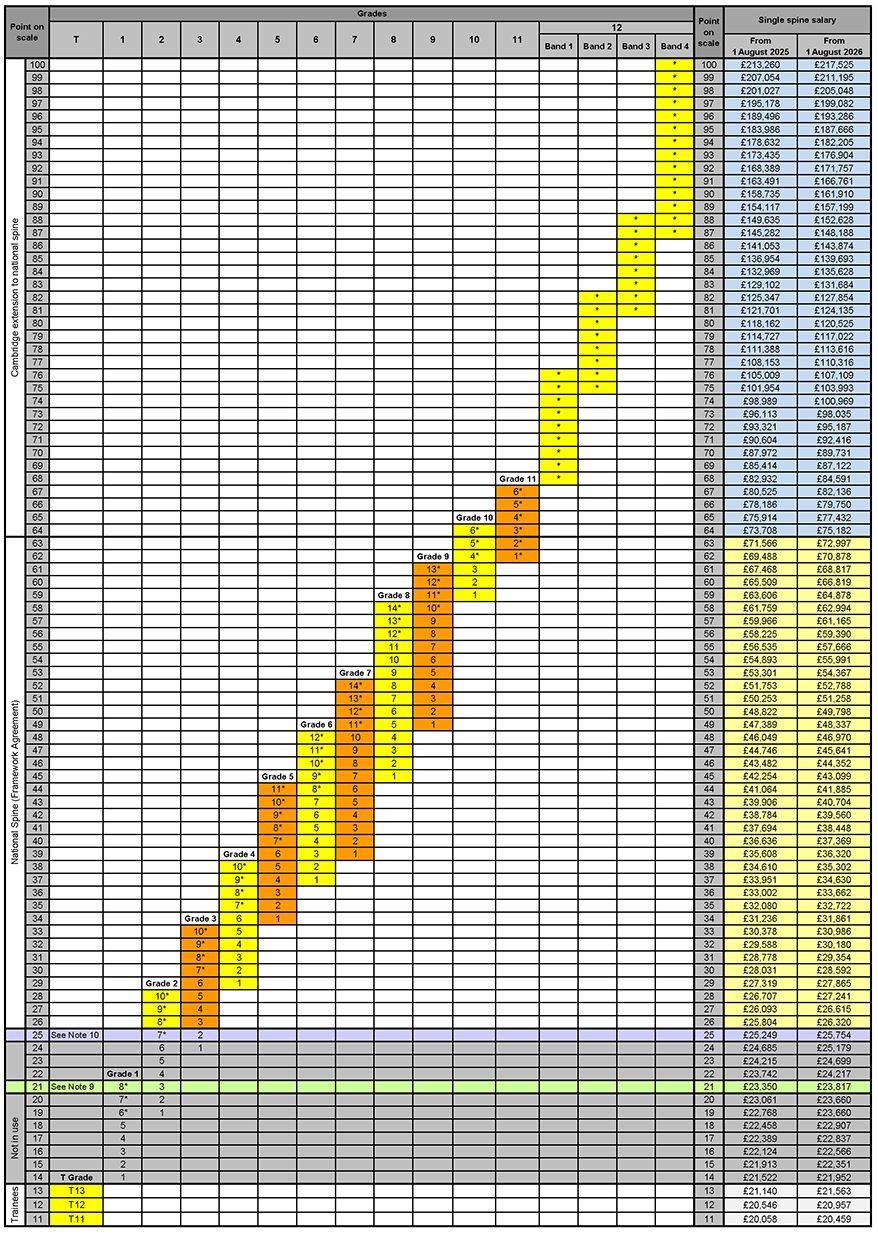
Cambridge Single Salary Spine as at 1 August 2026
|
Notes to the University of Cambridge Single Salary Spine as at 1 August 2026 |
|
|
Note 1: |
An asterisk (*) denotes a contribution point and progress through these is awarded on merit. |
|
Note 2: |
Grade T is for staff who are studying for an approved qualification or undergoing ‘in-service’ training. |
|
Note 3: |
Assistant Professors and Associate Professors (Grade 9) will be appointed to Grade 9. Associate Professors (Grade 10) will be appointed to Grade 10. Professors (Grade 11) will be appointed to Grade 11. The minimum for Professors (Grade 11) will be point 63 of Grade 11. Prior to 1 October 2024, Professors (Grade 11) could only be appointed to point 2 in Grade 11 (spine point 63). The minimum for Professors at Grade 12 will be spine point 68 in band 1 of Grade 12. |
|
Note 4: |
Academic-related professorial-equivalent staff will be appointed on the contribution bands of Grade 12 according to the HERA points boundaries for each level. |
|
Note 5: |
Specific arrangements will apply to progression in service-related points on some grades in compliance with the Memorandum of Understanding. |
|
Note 6: |
Incremental progression through the service related points occurs on the incremental date which will normally be on the anniversary of appointment or 1 April, 1 July or 1 October respectively for staff engaged on terms and conditions for Manual, Clerical/Secretarial and Technical Division appointments. |
|
Note 7: |
Points 32 and 50 were aligned to the National Single Pay Spine for Higher Education Academic and Support Staff, as negotiated by the Universities and Colleges Employers Association on behalf of UK higher education employers, with effect from 1 January 2014. |
|
Note 8: |
UCEA has removed spine points 13 to 18 from the National Spine and therefore they are no longer included in Grade 1. |
|
Note 9: |
Direct employees of the University appointed to Grade 1 will not be paid below spine point 21 from 1 November 2022. |
|
Note 10: |
Direct employees of the University appointed to Grades 2 or 3 will not be paid below spine point 25 from 1 January 2026. |
The Cambridge Students’ Union gives notice that elections for student academic representatives (subject and school) will be held on 19–22 October 2026. Nominations must be received by 9 a.m. on Wednesday, 14 October 2026. A full list of roles and more details about the process for election are available on the Cambridge Students website at https://www.cambridgestudents.cam.ac.uk/student-elections.