
No 6823
Thursday 7 May 2026
Vol clvi No 28
pp. 445–464
12 May, Tuesday. Discussion by videoconference at 2 p.m. (see below).
14 May, Thursday. Scarlet Day. Ascension Day.
21 May, Thursday. Easter Term divides.
22 May, Friday. Congregation of the Regent House at 10 a.m.
23 May, Saturday. Congregation of the Regent House at 10 a.m.
24 May, Sunday. Scarlet Day. Whitsunday.
26 May, Tuesday. Discussion by videoconference at 2 p.m. (see below).
|
Discussions (Tuesdays at 2 p.m.) |
Congregations (at 10 a.m. unless otherwise stated) |
|
12 May 26 May 2 June 16 June 30 June 14 July |
22 and 23 May 24 June, 2.45 p.m. (Honorary Degrees) 1, 2, 3 and 4 July (General Admission) 23, 24 and 25 July |
The Vice-Chancellor invites members of the Regent House, University and College employees, registered students and others qualified under the regulations for Discussions (Statutes and Ordinances, 2024, p. 111) to attend a Discussion by videoconference on Tuesday, 12 May 2026 at 2 p.m. The following item will be discussed:
1.Report of the General Board, dated 31 March 2026, on the establishment of a Faculty of Government (Rokos School of Government) (Reporter, 6821, 2025–26, p. 417).
Those wishing to join the Discussion by videoconference should email Discussions@admin.cam.ac.uk providing their CRSid (if a member of the collegiate University), by 10 a.m. on the date of the Discussion to receive joining instructions. Alternatively contributors may email their remarks to Discussions@admin.cam.ac.uk, by no later than 10 a.m. on the day of the Discussion for reading out by the Proctors,1 or may ask someone else who is attending to read the remarks on their behalf.
In accordance with the regulations for Discussions, the Chair of the Board of Scrutiny or any ten members of the Regent House2 may request that the Council arrange for one or more of the items listed for discussion to be discussed in person (usually in the Senate-House). Requests should be made to the Director of Governance and Compliance, on paper or by email to UniversityDraftsman@admin.cam.ac.uk from addresses within the cam.ac.uk domain, by no later than 9 a.m. on the day of the Discussion. Any changes to the Discussion schedule will be confirmed in the Reporter at the earliest opportunity.
For general information on Discussions see the Reporter website at https://www.reporter.admin.cam.ac.uk/discussions.
1Any comments sent by email should please begin with the name and title of the contributor as they wish it to be read out and include at the start a note of any College and/or Departmental affiliations held.
2https://www.scrutiny.cam.ac.uk/ and https://www.admin.cam.ac.uk/reporter/regent_house_roll/.
The Vice-Chancellor invites members of the Regent House, University and College employees, registered students and others qualified under the regulations for Discussions (Statutes and Ordinances, 2024, p. 111) to attend a Discussion by videoconference on Tuesday, 26 May 2026 at 2 p.m. The following item will be discussed:
1.Consultation on proposals for changes to senior administrative offices (p. 447).
Those wishing to join the Discussion by videoconference should email Discussions@admin.cam.ac.uk providing their CRSid (if a member of the collegiate University), by 10 a.m. on the date of the Discussion to receive joining instructions. Alternatively contributors may email their remarks to Discussions@admin.cam.ac.uk, by no later than 10 a.m. on the day of the Discussion for reading out by the Proctors,1 or may ask someone else who is attending to read the remarks on their behalf.
In accordance with the regulations for Discussions, the Chair of the Board of Scrutiny or any ten members of the Regent House2 may request that the Council arrange for one or more of the items listed for discussion to be discussed in person (usually in the Senate-House). Requests should be made to the Director of Governance and Compliance, on paper or by email to UniversityDraftsman@admin.cam.ac.uk from addresses within the cam.ac.uk domain, by no later than 9 a.m. on the day of the Discussion. Any changes to the Discussion schedule will be confirmed in the Reporter at the earliest opportunity.
For general information on Discussions see the Reporter website at https://www.reporter.admin.cam.ac.uk/discussions.
1Any comments sent by email should please begin with the name and title of the contributor as they wish it to be read out and include at the start a note of any College and/or Departmental affiliations held.
2https://www.scrutiny.cam.ac.uk/ and https://www.admin.cam.ac.uk/reporter/regent_house_roll/.
The Council has approved the following report as part of a consultation on proposals to redistribute the duties currently assigned to the Registrary and the Chief Financial Officer. The timetable below sets out the main dates for that consultation.
The report will be placed on the agenda of an additional Discussion on 26 May (see p. 446). There will also be an all‑staff meeting on 11 May, which will be an opportunity to ask questions informally about the proposals. The all-staff meeting will be open to all members of the University via MS Teams; for information and joining instructions see https://www.training.cam.ac.uk/event/6313271 (University account required).1 Comments on the proposals are also welcomed by email to consultationresponses@admin.cam.ac.uk. The Council expects to publish a response to the comments made through these channels by 17 June 2026.
|
All-staff meeting via MS Teams |
3.45–4.45 p.m. on Monday, 11 May 2026 |
|
Discussion via MS Teams |
2–4 p.m. on Tuesday, 26 May 2026 |
|
Deadline for consultation responses |
4 p.m. on Tuesday, 26 May 2026 |
|
Council response to comments/Discussion remarks published in the Reporter |
17 June 2026 |
1. With the vacancy in the office of Registrary and upcoming departure of the Chief Financial Officer (CFO), there is an opportunity to reorganise the responsibilities of those two offices to help modernise the University structures and processes. As those changes will entail amendments to the University’s Statutes and Ordinances, the Council is publishing this report to give members of the Regent House and others in the University and the Colleges the opportunity to provide feedback on its proposals more broadly and on draft amendments to Statutes and Ordinances (see Annex A).
2. The Council considers that changes are needed to address current academic and operational challenges at the University, and also to make the workload of the Registrary more manageable. As the main proposal is to reshape two existing senior administrative offices, the costs associated with the changes are not significant.
3. On the academic side, there is a need for enhanced academic planning and prioritisation. In particular, there is a need to define and make effective the role of the Schools in strategic decision-making alongside the new budgeting and academic and financial planning arrangements enabled by Enhanced Financial Transparency. It will also be important to ensure that the University’s committee structure is effective in supporting the University’s decision-making in setting and implementing those priorities – and the processes are broadly endorsed by the Regent House and the wider internal community.
4. On the operational side, there is a need for central coordination of UAS/UIS resources and activity, and the delivery of a more effective and efficient professional services operating model that is more integrated across the University. This is critical to the realisation of benefits available from the new financial, research and HR systems. It will also be important to promote a culture of delivery and accountability within defined parameters that is widely understood and respected by the internal community.
5. Furthermore, the office of Registrary has had a broad and, at times, unmanageable, set of responsibilities requiring a skillset seldom found in one individual. The breadth of the current duties encompass a wide range of activities, covering responsibilities akin to those of a company secretary as well as front-line operational management of finance, estates and human resources. A reorganisation allows for the creation of coherent and manageable roles, with the remit of each role more effectively aligned with a specific skillset.
6. It is therefore proposed that the University replace the current offices of Registrary and CFO with two revised offices. A Chief Operating Officer (COO) would be responsible for managing the operational aspects of the University. A revised remit for the Registrary would focus on the pressing academic issues identified above. Under these plans, a significant part of the Registrary’s role would involve engaging with the wider academic community and its formal structures such as the Regent House and the Board of Scrutiny, drawing the attention of the Council and other relevant committees to issues as they arose. The Registrary would oversee the Academic Secretary’s work in coordinating academic strategy (what the University is seeking to achieve), with the COO focused on how to deliver it. The Academic Secretary would continue to report to the Registrary (primary reporting line) in relation to matters of academic planning, processes and decision-making and have a secondary reporting line to the COO on operational matters.
7. In terms of organisational restructuring, the COO would:
•take over from the Registrary the leadership of the UAS Divisions responsible for non-academic operations (including Finance) and responsibility through the Academic Secretary for all operational matters related to education and research;
•take over from the Vice-Chancellor the responsibility for line management of the Director of Information Services (with the UIS becoming a Division within the UAS);
•take primary responsibility for the operational planning at Schools and Non-School Institutions (NSIs) through the School Secretaries;
•take over from the CFO oversight of Cambridge University Press & Assessment, the non-operational estate and financial investments, the capital plan and investment appraisal (supported by a new small directorate – identified as ‘Planning and Investments’ in the chart in Annex B);
•lead and coordinate the University’s sustainability initiatives.
8. The CFO’s remaining roles in terms of budgeting, business planning and long-term financial forecasting would be transferred to a Director of Finance who would report to the COO.2
9. The heads of the University’s Development and Alumni Relations and External Affairs and Communications would continue to report directly to the Vice-Chancellor, but they would be responsible to the COO for budget co-ordination and operational matters.
10. It will be imperative that the Registrary, Academic Secretary and COO work very closely together and have an open and constructive relationship to ensure that academic strategies are both ambitious and deliverable, ensuring that the University of Cambridge remains a leading institution globally for the foreseeable future.
11. Both the Registrary and COO would support the wider senior leadership teams in their respective roles. For the Pro-Vice-Chancellors (PVCs), that would involve the Registrary (through the Academic Secretary) supporting the development of cross-University initiatives (e.g. a move to digital assessment) from an academic and governance perspective while the COO would be involved in the technical delivery. Likewise, Heads of Schools/NSIs would be supported by the Registrary (through the Academic Secretary) in terms of academic planning and prioritisation and by the COO in terms of delivering the necessary operational resources.
12. The Council has set out in this report a model in which there would be two senior administrative officers, with the Academic Secretary continuing to report to the Registrary. It gave serious consideration to a tripartite model in which the Registrary, the COO and the Academic Secretary would be peers, all reporting to the Vice-Chancellor as Chair of the Council, with the Academic Division as a third pillar alongside the Divisions under the Registrary and COO. In the end, the Council’s preference, by a small margin, was for the Registrary role to continue to be a major office in the University but refocused on academic planning and engagement, providing a counterweight to the COO’s expertise on core operations. However, it welcomes comments specifically on this tripartite alternative, in which the Registrary role would be more akin to that of a University Secretary in other universities.
13. Decision-making would continue to be made by committees as now. There is no intention to increase executive power but to use existing authority more effectively in coordinating the University’s objectives and resources. Both the Registrary and the COO would have the same responsibilities to the Council as the Registrary and the CFO currently have and would report to the Vice-Chancellor as Chair of the Council.
14. The Council also considered that it was important that relevant committees continued to hear directly from the University’s most senior finance officer. The Director of Finance would continue to attend key committees (including the Council as appropriate) to provide a direct report on the University’s financial position and financial risks and opportunities; and in particular would maintain a close relationship with the Chair of the Audit Committee.
15. Figures 1.1, 1.2 and 1.3 in Annex B illustrate the reporting relationships, the way the PVCs will interact with the new management structure and how the new management structure will interact with the Schools3 and other NSIs to deliver the necessary academic and operational change. The exact split of responsibilities is subject to further discussion and consultation, and in any event may change over time as circumstances change.
16. The Council hopes to publish a Report recommending final changes to Statutes and Ordinances, reflecting the feedback received, later in the Easter Term.
1A message about this meeting was sent to all University staff on 30 April 2026.
3Libraries and Collections are expected to have the same relationship with the management structure as shown for Schools.
The changes below:
•revise the Statutes so that the Registrary and COO can be one or two offices;
•extend the Council’s current ability to delegate the duties of the Registrary to other officers
oto cover delegations of the duties of the COO to other officers; and
oalso enable the Council to delegate the duties of the Registrary and/or COO to postholders;
•move the duties of the Registrary to Special Ordinance and split them between the Registrary and COO;
•revise the Ordinance for the UAS so that it reflects that split of duties;
•create a new Investment Appraisal Division and incorporate UIS as an Information Services Division;
•insert a new office of Assistant Operating Officer (including the grades of Principal Assistant and Senior Assistant), equivalent to Assistant Registrary/Treasurer;
•rescind the Ordinance for UIS, as the matters it covers will be provided for by the Ordinance for UAS;
•insert references to the COO alongside the Registrary in some places;
•replace a few references to the Registrary with references to the COO (the majority of tasks currently undertaken by the Registrary remain relevant to the Registrary’s updated duties).
1. By amending Statute C VI (Statutes and Ordinances, 2024, p. 20) to read as follows:
1. The Registrary and Chief Operating Officer shall perform such duties as may be prescribed by Statute or Ordinance or by the Council. The Registrary and Chief Operating Officer shall be appointed by the Council and placed under its direction through the Vice-Chancellor. If the Council determines that there shall be two officers, one designated as the Registrary and the other designated as the Chief Operating Officer, the Vice-Chancellor shall determine the allocation of such duties that are not allocated by Ordinance between those officers from time to time, provided that neither shall be a member of the Council. During a vacancy, the Council may appoint an Acting Registrary and Chief Operating Officer (or an Acting Registrary or Acting Chief Operating Officer as the case may be) upon such terms of remuneration as it thinks fit.
2. There shall be under the direction of the Council administrative officers in categories determined by Ordinance and postholders. So far as the Council may allow or direct, any duty of the Registrary and Chief Operating Officer may be performed by such an officer or postholder.
2. In Statutes A VII 4 and C I 1(a) (Statutes and Ordinances, 2024, p. 9 and p. 16) by replacing references to the Registrary with references to the Registrary and Chief Operating Officer.
3. By amending Special Ordinance C (iv) (Statutes and Ordinances, 2024, p. 79) to read as follows:
The Registrary and Chief Operating Officer
(Special
Ordinance under Statute C VI)
1. It shall be the duty of the Registrary
(a)to act as the principal governance and academic planning officer of the University, and the head of the University’s administrative staff supporting governance, policy and planning activities;
(b)to keep a record of the proceedings of the University, and to attend for that purpose all Congregations of the Regent House and such other public proceedings of the University as may be specified by Statute or Ordinance or by the Council;
(c)to act as Secretary to the Council;
(d)to receive reports of Boards, Syndicates, and other bodies, and to deal with them as required by Statute or Ordinance;
(e)to be responsible for maintaining a register of members of the University, and keeping records of matriculations and class-lists, and of degrees, diplomas, and other qualifications;
(f)to edit Statutes and Ordinances and the Cambridge University Reporter;
(g)to issue such certificates as may be required in accordance with Statute A II 8;
(h)to witness the affixing of the Common Seal, or appoint deputies to do so, and to carry out related duties as set out in Statute A II 13(c);
(i)to perform such other duties as may be prescribed by Statute or Ordinance or by the Council.
2. It shall be the duty of the Chief Operating Officer
(a)to act as the principal operations officer of the University, and the head of the University’s administrative staff supporting operations;
(b)to issue such certificates as may be required in accordance with Statute J 11;
(c)to perform such other duties as may be prescribed by Statute or Ordinance or by the Council.
4. By inserting references to the Chief Operating Officer in the following after the references to the Registrary:
Special Ordinance A (i) (a)(i) (Statutes and Ordinances, 2024, p. 67)
Schedule G (i) 1 (Statutes and Ordinances, 2024, p. 106)
Regulation 4 of the Ordinance for the Nomination of Members of the Council in Class (e) (Statutes and Ordinances, 2024, p. 119)
Regulations 1 and 5 of the Ordinance for the Order of Seniority of Graduates (Statutes and Ordinances, 2024, p. 176)
Regulation 4 of the Ordinance for Academical Dress (Statutes and Ordinances, 2024, p. 177)
Regulation 3 of the Ordinance for Addresses to the Sovereign and Formal Letters to Other Universities (Statutes and Ordinances, 2024, p. 181)
Ordinance for Emeritus Officers (Statutes and Ordinances, 2024, p. 674)
5. In the Ordinance for the UAS (Statutes and Ordinances, 2024, p. 693, as amended by Grace 1 of 15 January 2025 and part (a) of Grace 2 of 22 April 2026)
(a) by amending Regulations 1, 2, 3, 6(c) and 7(a) to read as follows and retaining existing footnotes:
1. (a) The staff of the University Offices shall form a Unified Administrative Service which shall be under the supervision of the Council and shall comprise the following Divisions split between (i) Operations and (ii) Governance and Academic Planning:
Operations
Estates Division
Finance Division
Health, Safety, and Regulated Facilities Division
Human Resources Division
Information Services Division
Investment Appraisal Division
Governance and Academic Planning
Academic Division
Governance and Compliance Division
Legal Services Division
2. (a) Under the provisions of Special Ordinance C (iv), within the Unified Administrative Service the head of Governance and Academic Planning shall be the Registrary and the head of Operations shall be the Chief Operating Officer.
(b) Under the direction of the Council, the Registrary and the Chief Operating Officer shall manage their staff within University Offices and their staffing, budgets, space, and other resources provided to the Offices by the Council. It shall be the duty of the Registrary and the Chief Operating Officer to ensure that arrangements for the quality assurance of the services provided by the Offices are presented to the Council and are implemented as agreed by the Council. The Registrary and the Chief Operating Officer shall make such reports on the work of the University Offices to the Council as that body may require.
(c) The Chief Operating Officer, or a University officer appointed by the Chief Operating Officer, shall be the Establishment Licence Holder for facilities regulated by the Animals (Scientific Procedures) Act 1986.
3. Within each Division of the Unified Administrative Service there shall be the University office of Director (or such other title as may be determined from time to time by the Council) who shall be head of the Division and whose duties shall include the management of the Division, under the overall responsibility of the Registrary or the Chief Operating Officer.
[6](c)(i) the Registrary if the appointment is in a Governance and Academic Planning Division or the Chief Operating Officer if the appointment is in an Operations Division (or a deputy appointed by the relevant officer);
(ii)the Director of the Division in which the appointment is to be made (except where it is the Director of the Division who is to be appointed or reappointed);
[7.](a) Appointments and reappointments to the offices of Director, Deputy Director, Assistant Director, Principal Assistant Registrary, Principal Assistant Operating Officer, Principal Assistant Treasurer, Senior Assistant Registrary, Senior Assistant Operating Officer and Senior Assistant Treasurer shall be made by the Standing Appointments Committee on the recommendation of an Appointing Committee, the membership of which shall be approved by the Chair of the Standing Appointments Committee, which shall consist of the Registrary if the appointment is in a Governance and Academic Planning Division or the Chief Operating Officer if the appointment is in an Operations Division (or a deputy appointed by the relevant officer), the Director of the Division in which the appointment is to be made, an appropriate senior academic-related officer, a senior academic with experience and interest in what the role of the office entails, and a member of the Standing Appointments Committee in class (b).
(b) in Regulations 4 and 8 by inserting ‘, Assistant Operating Officer’ after ‘Assistant Registrary’, in Regulation 8 by inserting ‘and Chief Operating Officer’ after ‘the Registrary’, and in Regulation 11 by inserting ‘, Chief Operating Officer’ after ‘the Registrary’ in two locations.
6. By rescinding the Ordinance for University Information Services (Statutes and Ordinances, 2024, p. 672).
7. By replacing references to the Registrary with references to the Chief Operating Officer in the following Ordinances:
Regulation 1(b)(ii), University and Staff Joint Board (Statutes and Ordinances, 2024, p. 127)
Regulation 1(g), Information Services Committee (Statutes and Ordinances, 2024, p. 138)
8. The following changes to Notices and Regulations not in Ordinance would also be made:
(a) In the Notice on Appointing arrangements for certain academic-related offices (reproduced in Statutes and Ordinances, 2024, p. 675), in paragraph 3 by replacing references to ‘the Registrary’ with references to ‘the Registrary or the Chief Operating Officer, as appropriate’, and in the Schedule to paragraph 9 by replacing the paragraph about the Head of the institution for an office established in an institution under the supervision of the Unified Administrative Service with ‘The Chief Operating Officer’.
(b) In the Notice on University maternity leave and other family-related leave policy (reproduced in Statutes and Ordinances, 2024, p. 679, as amended with effect from 1 October 2024) by revising the second sentence of the second paragraph to read as follows:
A University officer who intends to take maternity leave shall give notice of that fact by the fifteenth week before the expected week of childbirth, through the Personnel Consultant assigned to the officer’s institution, to the Chief Operating Officer.
(c) In the Financial Regulations (reproduced in Statutes and Ordinances, 2024, p. 1056), in paragraphs 6.4 and 7.1 by inserting references to the Chief Operating Officer in the bulleted lists, in paragraphs 8.1, 18.3(a) and 20.1 by replacing the references to the Registrary with references to the Chief Operating Officer, and in paragraph M by replacing the seventh bullet with the following:
The Registrary is the principal governance and academic planning officer and the Chief Operating Officer is the principal operations officer of the University. They are the heads of the University’s administrative staff supporting, respectively, governance and academic planning, and operations, under the direction of the Council.[1]
[1] Special Ordinance C (iv) 1 and 2.
(d) In the Sites and Buildings Regulations (reproduced in Statutes and Ordinances, 2024, p. 1066), in paragraphs 1.6 and 3.4 by replacing references to the Registrary with references to the Chief Operating Officer.
(e) By replacing a reference to the Registrary with a reference to the Chief Operating Officer in the footnote attached to the Joint Notice on Additional Payments for Administrative Responsibility (Statutes and Ordinances, 2024, p. 688).
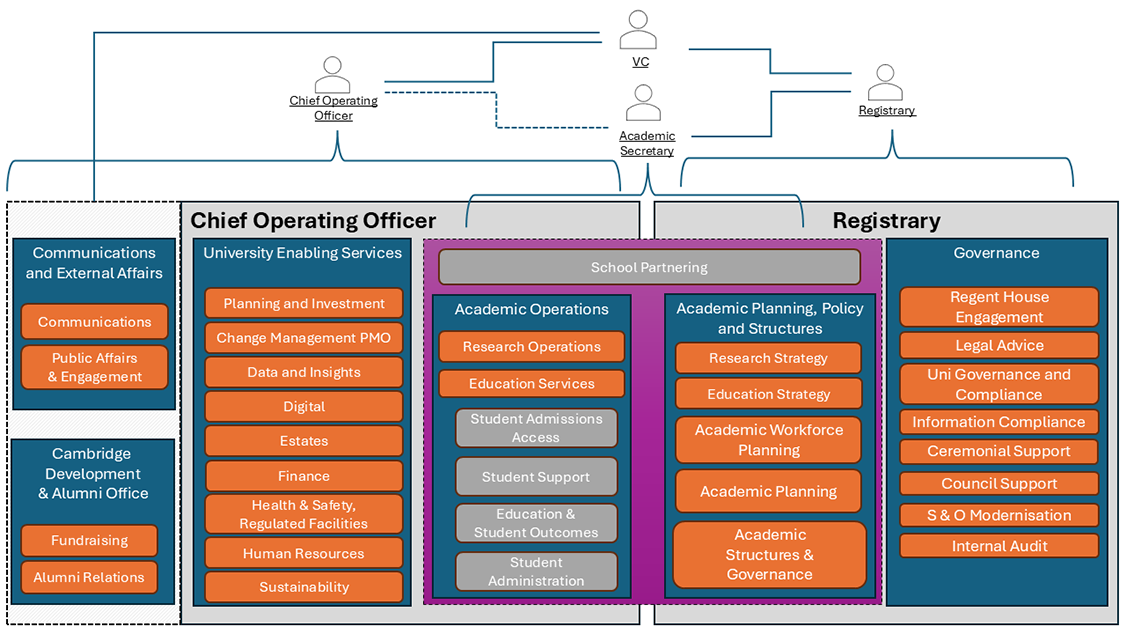
The Registrary and COO report to the Vice-Chancellor as Chair of the Council.
The activities shown below each position are activities rather than organisational divisions – they are illustrative and non-exhaustive.
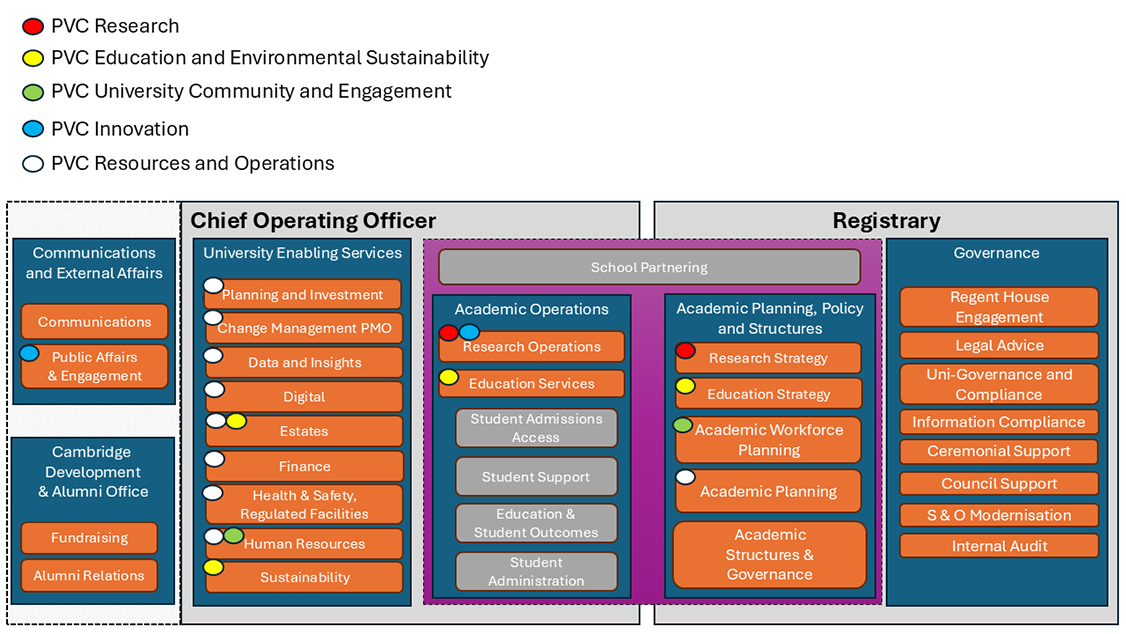
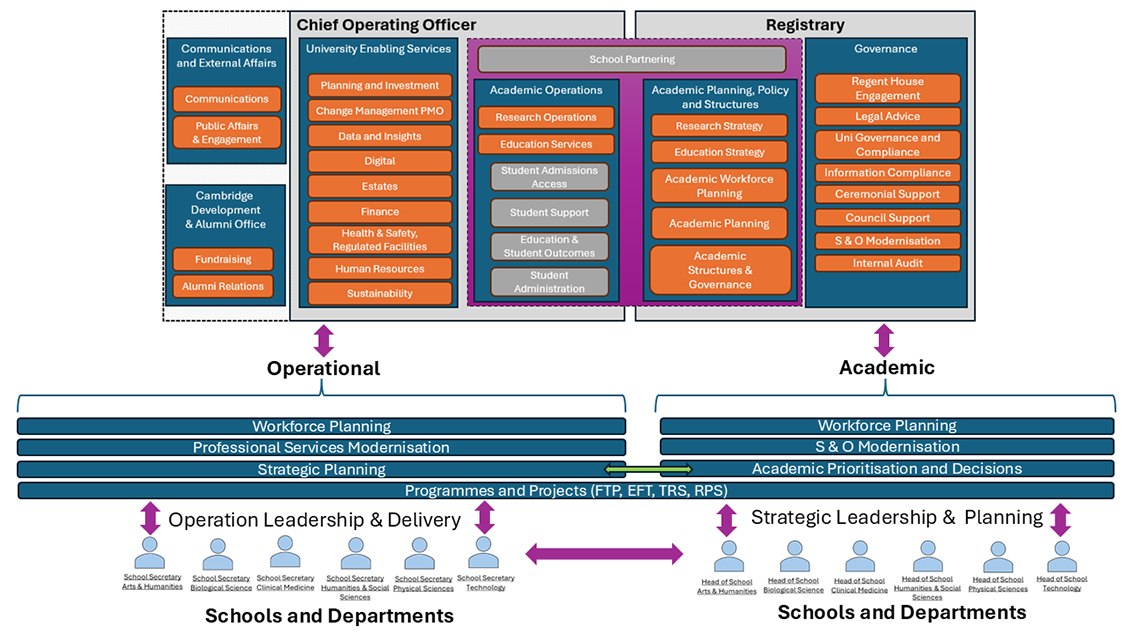
Figure 1.3 is not seeking to suggest that the School Secretaries report directly to the COO. It illustrates that for operational matters the School Secretaries will be responsible to the COO to ensure overall efficiency and effectiveness. They will continue to work with the Heads of the Schools and the Academic Secretary on academic planning and prioritisation as they do now. This is illustrated by the two-way arrow between ‘Operational Leadership and Delivery’ and ‘Strategic Leadership and Planning’.
Nominations are invited from members of the University community for the award of honorary doctorates. Full details about eligibility to nominate for and to receive such degrees and the process are published online at https://www.cam.ac.uk/about-the-university/how-the-university-and-colleges-work/processes/honorary-degrees/the-nomination-and-approval-process, where a list of honorary degrees conferred since 1977 may also be found.
The University Council’s Honorary Degree Committee would welcome nominations of persons of national or international distinction and especially of those whose work promotes the University’s mission and core values1. Such distinction may be in any field (and any genre within a field) and need not always relate closely to academic achievement. The Committee wishes to increase the breadth and diversity of its field of candidates, both in terms of background (for instance, gender and ethnicity) and area of achievement.
The Committee has simplified the process for making nominations, which should be submitted via the online form.