
The University and its Departments
Honorary Degrees
The University of Cambridge has been conferring honorary degrees for some 500 years. One of the earliest recorded ceremonies was in 1493, when the University honoured the poet John Skelton. An honorary degree is the highest accolade the University can give.
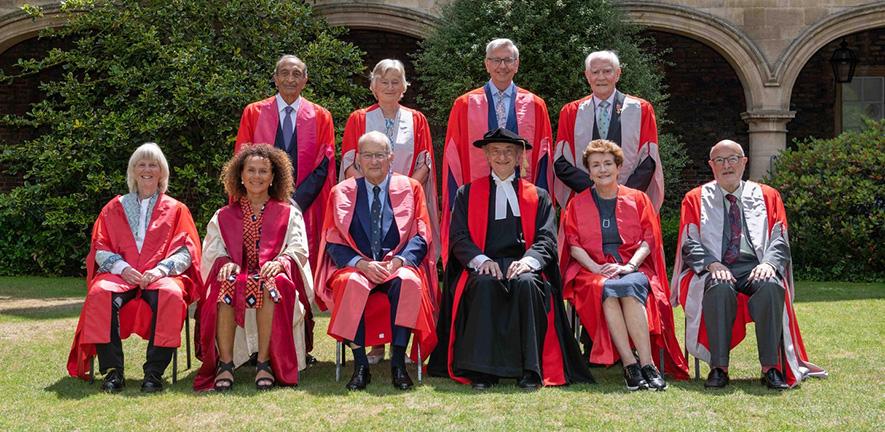
The conferment of honorary degrees usually takes place in late June. The ceremony is a colourful one and is held in the University's Senate-House. The chosen day is declared a 'scarlet day', when doctors wear their impressive 'festal' gowns and all other University members attending the ceremony wear full academical dress.
University and College buildings fly flags to mark the occasion. While the bells of the University Church ring out, processions assemble and make their way around the yard of the Senate-House.
The 2009 Honorary Degree Congregation was held on Friday, 12 June 2009. The Orations for the honorary graduates are published in the Reporter, and a video of the ceremony, including interviews with the honorands, is available online. The Orations are also available for the recipients of the two Honorary MA degrees conferred on Saturday, 18 July 2009.
The date of the 2010 Congregation, and the honorands, will be announced in due course.
How honorary graduates are chosen
The University's Statutes provide for the conferment of titles of degrees honoris causa ('as a mark of honour') on "members of the Royal Family, British subjects who are of conspicuous merit or have done good service to the State or to the University, and foreigners of distinction."
Proposals for honorary degrees must be considered by the University's Council. Any person may suggest a name and several dozen proposals are made each year. These are reviewed by a committee of the Council, chaired by the Vice-Chancellor, which makes final recommendations.
Early in the calendar year, when the Council has approved a short-list and the consent of the nominees has been obtained, the nominations are published. They are submitted as 'graces' to the Regent House, the governing body of the University that must be invited to approve all proposals for degrees. Occasionally there may be a vote, as happened most recently in 1998. About nine distinguished persons are usually nominated each year.
Gowns and titles
Those to be honoured are called honorands or graduands before the ceremony has taken place. The degrees awarded are honorary doctorates in divinity (D.D.), law (LL.D.), science (Sc.D.), letters (Litt.D.), and music (Mus.D.). Occasionally, the University will award an honorary Master of Arts degree, usually to recognise exceptional service in a local context.
The gowns worn for this occasion by honorary graduands are impressive. Most are of scarlet cloth with coloured silk linings and facings, except for the Mus.D. degree, which has cream damask and cherry-silk robes. Bonnets are made of black velvet with gold cords and tassels, apart from the Doctors of Divinity, who wear a special black velvet cap.
Procession and ceremony
The first procession to pass around Senate-House Yard is led by the Vice-Marshal and consists of the Heads of the Colleges, Professors and holders of Cambridge Higher Doctorates.
After a pause, a second procession follows, led by the two Esquire Bedells carrying the University maces. They precede the Chancellor, HRH The Duke of Edinburgh, the Vice-Chancellor and other senior officers of the University and also the honorary graduands themselves. This second procession is welcomed into the Senate-House by a fanfare of trumpets.
The ceremony is called a Congregation of the Regent House and officially begins when the two Proctors, the formal representatives of the Regent House, announce the start of business. A short musical recital follows, usually given by a college choir.
The ceremonial proceedings are quite simple and are conducted entirely in Latin. Each honorand is led forward in turn and stands in front of the Chancellor. The University Orator makes a short speech of presentation, marking the achievements of the honorand. At the end, the Orator leads the honorand to the Chancellor, who stands, takes the graduand's right hand, and confers the degree using a prescribed formula. There is then an opportunity for applause.
After the final graduand has been admitted, there is a further short choral recital and the National Anthem is sung by the choir. The Bedells lead the Chancellor and his suite in a procession out of the Senate-House and either back around Senate-House Yard or directly to the college where a celebratory luncheon is to be held if that college is nearby.
Famous people
Many great historical figures have been honoured by the University of Cambridge, including Albert Einstein, Max Planck, Lord Kitchener, General Eisenhower and Field Marshal Montgomery.
In more recent years, those honoured include:
World leaders
- Dr Manmohan Singh, Prime Minister of India
- President Fernando Henrique Cardoso of Brazil
- President Kim Dae-Jung of the Republic of Korea
- Chancellor Helmut Kohl of Germany
- President Nelson Mandela of South Africa
- President Mary Robinson of the Republic of Ireland
- President Shankar Dayal Sharma of India
- King Juan Carlos and Queen Sofía of Spain
Business and industry
- Dr John Bradfield
- Sir Adrian Cadbury
- Sir John Harvey-Jones
- Sir Alistair Pilkington
- Gordon Moore
Scientists
- David Attenborough
- Jocelyn Bell Burnell
- Stephen Hawking
- Nevill Mott
- Frederick Sanger
- James Watson
Religion
- Cardinal Hume
- Archbishop Runcie
- Mother Teresa
- Chief Rabbi Dr Jonathan Sacks
- Bishop of Liverpool, David Sheppard
- Archbishop Desmond Tutu
- Archbishop of Liverpool, Derek Worlock
Arts
- Dame Ninette de Valois
- Nadine Gordimer
- Sir Alec Guinness
- Ted Hughes
- Dame Iris Murdoch
- V.S. Naipaul
- Elizabeth Schwarzkopf
- Dame Maggie Smith
- Dame Kiri Te Kanawa

